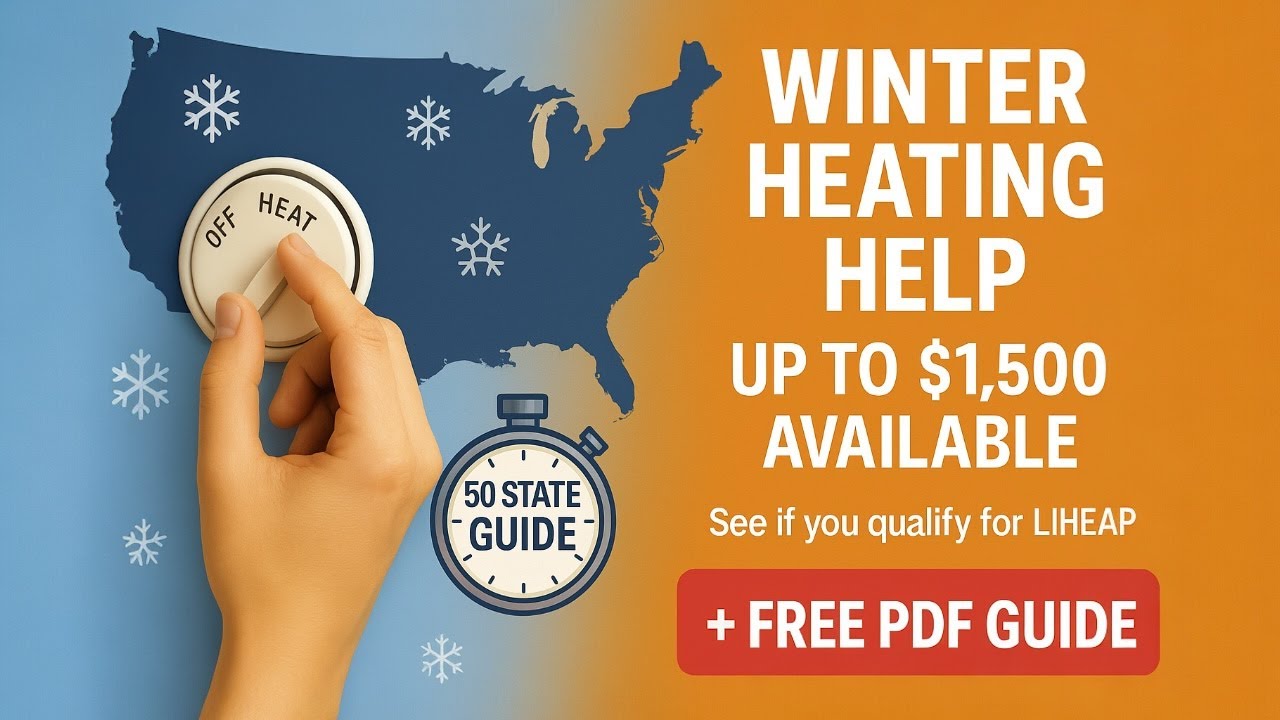
How to Apply for LIHEAP: Winter Heating Help 2025
There is no single national application, so how to apply for LIHEAP depends entirely on where you live. There are roughly 50 separate programs, one per state, each with its own income limit, opening date and pot of money. Most states hand it out first come, first served. The useful question is not whether you qualify, but when your state opens and what you need ready before that day.
Watch this step-by-step GovClarity video guide. Subscribe to our YouTube channel for new guides every week.
Information sourced as of September 2025. The income limits, benefit ranges and state opening dates below cover the 2025 to 2026 heating season and match our companion PDF guide, which was compiled from the federal fiscal year 2025 program guidelines. Every state resets its numbers each year, so confirm current figures with your own state before you apply.
The one thing to take away
There is no single national LIHEAP application. There are roughly 50 separate programs, one per state, each with its own income limit, its own opening date and its own money.
That matters because the funding is finite and most states hand it out first come, first served. A household that applies the week its state opens is in a very different position from an identical household that applies in February.
So the useful question is not “do I qualify” but “when does my state open, and what do I need ready before that day”.
What LIHEAP actually is
The Low Income Home Energy Assistance Program, almost always shortened to LIHEAP, is a federally funded program that helps lower income households pay their home energy bills. It is aimed at heating in winter and cooling in summer, and in most cases the money never touches your bank account. It goes straight to your utility company or fuel vendor as a credit on your account.
The federal government funds it. Your state runs it. That split is the source of nearly all the confusion around this program, because two households in neighbouring states with identical income and identical bills can get very different answers.
For the 2026 federal fiscal year, the Senate Appropriations Committee proposed roughly $4.0 billion for LIHEAP nationally. Spread across every eligible household in the country, that is not a large pot, which is why timing matters as much as eligibility.
The three kinds of help, and which one you need
People often apply for the wrong one, or do not realise a second one exists. There are three components:
| Component | What it does | What it takes to qualify | Who gets paid |
|---|---|---|---|
| Regular LIHEAP | A one time payment toward seasonal heating or cooling bills | Income, household size and energy burden | Your utility company or fuel vendor directly |
| Crisis assistance | Emergency help when you are about to lose service or run out of fuel | A shut off notice, a low fuel supply, or another verified emergency | Expedited, and in some states paid directly to you |
| Weatherization, the Weatherization Assistance Program | Physical work on your home to cut what it costs to heat | Income based, or automatic if you already receive certain benefits | The contractor who does the work |
These are not mutually exclusive. Receiving a regular LIHEAP payment in November does not stop you applying for crisis assistance in January if you then get a shut off notice, and neither one blocks a weatherization referral. Ask about all three when you apply, because many local offices will only process what you specifically requested.
Who qualifies
Every state picks one of two yardsticks. Most use 150 percent of the Federal Poverty Level. A smaller group, including several in the north east, uses 60 percent of State Median Income instead, which usually allows a noticeably higher income.
| State | Household of 1 | Household of 2 | Household of 3 | Household of 4 | Basis |
|---|---|---|---|---|---|
| Most states, including California, Texas, Florida, Georgia, Ohio and Colorado | $24,360 | $32,940 | $41,520 | $48,225 | 150% of the Federal Poverty Level |
| Alaska | $30,450 | $41,175 | $51,900 | $60,788 | 150% of the Federal Poverty Level |
| Hawaii | $28,014 | $37,881 | $47,748 | $55,789 | 150% of the Federal Poverty Level |
| Illinois | $46,062 | $62,934 | $79,806 | $76,884 | 60% of State Median Income |
| Maine | $42,503 | $58,087 | $73,671 | $70,839 | State specific formula |
| Connecticut, Maryland, New Hampshire, New Jersey, New York, Pennsylvania, Rhode Island | Contact state | Contact state | Contact state | Contact state | 60% of State Median Income |
The full 50 state table is in the companion PDF further down this page. Two points worth understanding before you read any of these numbers:
- Being over the line on paper is not always a rejection. Several states weigh energy burden, meaning what proportion of your income goes to utilities, alongside raw income.
- Receiving other benefits does not disqualify you. Supplemental Nutrition Assistance Program benefits, Temporary Assistance for Needy Families, and Supplemental Security Income are all compatible with LIHEAP, and in some states receiving them makes you automatically income eligible.
You do also need to be the person responsible for the energy bill. Renters qualify, including renters whose heat is included in the rent, but the paperwork is different and usually requires the lease or a signed statement from the landlord.
One change that catches households on both programs
The One Big Beautiful Bill Act of 2025 changed how a LIHEAP payment interacts with Supplemental Nutrition Assistance Program eligibility. Under the older rule, receiving LIHEAP could automatically trigger a higher utility allowance in the food benefit calculation, which raised the monthly benefit for a lot of households.
Now a household must include an elderly or disabled member for that automatic higher allowance to apply. If you receive both, this is worth a phone call to your local office rather than an assumption, because the interaction runs in both directions and varies by state.
What you can actually receive
Nationally the range runs from about $25 to about $1,500. Where you land inside that is decided by household size, income, the fuel you heat with and local energy costs, so a flat number is rarely available in advance.
| State | Regular benefit | Crisis assistance | Note |
|---|---|---|---|
| Arizona | Up to $640 | Up to $500 | Published state maximum |
| California | Up to $1,500 | Varies | Higher ceiling than most states |
| Florida | $400 to $1,350 | Varies | Wide range by local cost |
| New York | $400 to $900 | Varies | Range varies by circumstances |
| Pennsylvania | $200 to $1,000 | $25 to $1,000 | Wide range by need |
| Illinois | Calculated on energy burden | Varies | No fixed maximum |
LIHEAP is designed to reduce an energy bill, not to clear it. Households that budget around a full winter of covered heat are usually disappointed. Treat it as one payment that takes the top off the season.
When to apply, and why the date is the whole game
Most states open somewhere between September and November for the winter heating season. Many run a priority window first, where only certain households can apply, and then open to the general public a few weeks later.
| State | Priority groups open | General public opens | Deadline |
|---|---|---|---|
| Illinois | October 1, 2025 | November 1, 2025 | August 15, 2026, or until funds are exhausted |
| Maine | August 1, 2025 | August 1, 2025 | Check the state website |
| New York | November 3, 2025 | November 3, 2025 | Check the state website |
| All other states | Contact your state | Contact your state | Dates move every year |
Who gets the priority window
- Households with a member aged 60 or older
- Households with a member who has a disability
- Households with children under age 6
- Households with a high energy burden, generally where utilities exceed about 30 percent of household income
If any of those describe you, find your state’s priority opening date rather than its public one. That is often a full month of difference in a program where the money runs out.
What to have ready before you start
Incomplete applications are the single most common cause of delay, and in a first come, first served program a delay is not neutral. Gather all of this first:
Identity and household
- Government issued photo identification for the applicant
- Social Security numbers for everyone in the household. The physical cards are not always required
- Proof of citizenship or legal residency, such as a birth certificate, passport or immigration document
Income, for every household member over 18
- Recent pay stubs, four weeks for weekly pay or two months for other schedules
- Or a letter from the employer on company letterhead
- Or self employment records or tax forms
- Award letters for Social Security, Supplemental Security Income, unemployment, pension, Temporary Assistance for Needy Families or Supplemental Nutrition Assistance Program benefits
Utility and housing
- The past two to three months of bills for every energy source you use
- Your shut off notice, if you are applying for crisis assistance
- Your lease, if you rent, to show you are responsible for the utilities
- A landlord affidavit if the lease does not make that clear
- Vendor details if you heat with propane, oil or wood
If you are claiming a priority slot, bring the proof of it as well: medical documentation for a disability, or birth certificates for young children.
How to apply
Four routes exist in most states, and they are not equivalent. The gap between the fastest and the slowest is roughly a month.
| Method | Typical processing | Works well when | Drawback |
|---|---|---|---|
| Online | 1 to 2 weeks | You have your documents scanned and want the fastest route | Requires internet access and, usually, an account |
| In person | 1 to 3 weeks | Your paperwork is complicated or your situation needs explaining | Usually requires an appointment |
| Phone | 2 to 4 weeks | You want help but cannot travel | Long hold times at the start of the season |
| 3 to 6 weeks | Nothing else is workable | Slowest, and easiest to lose |
Whichever route you take: keep a copy of everything you submit, write down your confirmation number, and respond the same day if the agency asks for anything else. Applications sit in a pending queue while they wait on you, and the queue keeps moving without you.
Mistakes that cost people the money
Waiting until the bill hurts. By the time a January bill arrives, the fastest applicants have been approved for two months and some state funds are already committed.
Assuming you earn too much. The 60 percent of State Median Income states allow considerably more income than people expect, and energy burden can matter more than the raw figure.
Only asking for regular assistance. Crisis assistance and weatherization are separate requests. Nobody will offer them if you do not ask.
Submitting an incomplete application to beat the queue. It does not beat the queue. It goes to the back of it while somebody chases you for a pay stub.
Paying someone to help. Applying for LIHEAP is free, everywhere, always. Any service charging a fee to file your application is a third party and is not connected to the program.
📥 Free PDF Guide
Our free 14 page guide has the full 50 state income table, the maximum benefit amounts, the complete document checklist, and a phone number and website for every state agency. No email required.
Browse all our guides on the Free Guides page.
Frequently asked questions
Can I apply for LIHEAP if I already receive other benefits?
Yes. Supplemental Nutrition Assistance Program benefits, Temporary Assistance for Needy Families and Supplemental Security Income do not disqualify you, and in several states receiving one of them makes you automatically income eligible for LIHEAP.
What if I am already behind on my utility bills?
LIHEAP can be applied to past due balances, and being behind often strengthens rather than weakens your case. If you have received a shut off notice, ask specifically for crisis assistance, which is processed faster than a regular application.
How long does approval take?
Between one and six weeks depending on your state and how you applied. Online is typically 1 to 2 weeks, mail 3 to 6 weeks. Crisis applications are handled on a much shorter clock where a shut off is imminent.
Can renters get LIHEAP?
Yes, including renters whose heat is included in the rent, though the paperwork differs. You will usually need your lease, and if it does not clearly state who pays for utilities, a signed statement from your landlord.
Does LIHEAP pay me or my utility company?
Almost always the utility company or fuel vendor, as a credit on your account. Crisis assistance is the exception in some states, where the payment can go directly to the household.
Is there a national LIHEAP application?
No. Each state runs its own program with its own form, income limits and dates. Any website presenting itself as a single national application is not the program.
Can I apply every year?
Yes. LIHEAP is an annual program and prior year assistance does not count against you. You do have to reapply each season, and your state may require updated income documentation each time.
What happens if my state runs out of money?
Applications close for the season, even if you would otherwise have qualified. This is the reason the opening date matters more than any other detail in this guide. Some states reopen if additional federal funding is released later in the year, so it is worth checking again rather than assuming the door is shut.
Related GovClarity guides
- Can’t Afford Groceries? How to Get Up to $975/Month in SNAP Benefits (2025 Guide)
- FEMA Help: Your Step-by-Step Disaster Relief Guide (In Under 5 Minutes)
- FAFSA 2026-2027: Avoid Mistakes That Cost Thousands
- How to Apply for WIC in 2025: Step-by-Step Guide
Official resources
- National Energy Assistance Referral hotline, which routes you to your own state: 1-866-674-6327
- Federal program page: acf.hhs.gov/ocs/programs/liheap
- Find your state agency: liheapch.acf.hhs.gov
- A selection of state lines: Alabama 1-800-284-4340, California 1-866-675-6623, Florida 1-850-717-9000, Georgia 1-877-423-4746, Illinois 1-877-411-9276, Michigan 1-800-292-2780, New York 1-800-342-3009, North Carolina 1-877-626-4327, Ohio 1-877-644-6327, Pennsylvania 1-866-857-7095
- Every state, with website and local agency: in the free PDF guide above
Details as of September 2025, covering the 2025 to 2026 heating season. Income limits, benefit amounts, opening dates and contact numbers change every year and vary considerably by state, so confirm current details with your state agency before applying. GovClarity is not a government agency and does not process applications. Applying for LIHEAP is always free.