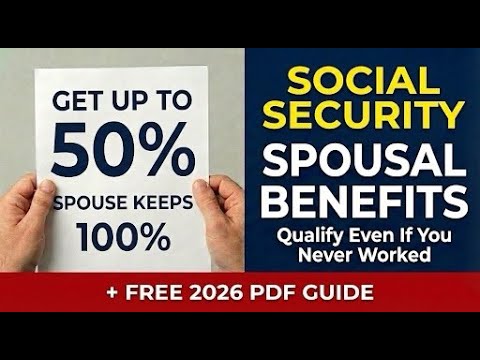
Social Security Spousal Benefits Explained: Who Qualifies & How to Apply (2026)
The most expensive misconception about Social Security spousal benefits is that you receive your own benefit plus half your spouse’s. You do not. You receive whichever is higher, your own or the spousal amount. If your own benefit is $1,200 and your spouse’s is $3,000, you are paid $1,500, not $2,700.
Watch this step-by-step GovClarity video guide. Subscribe to our YouTube channel for new guides every week.
Information sourced as of January 2026. The figures, rules and 2025 law change below were current when this guide was published and match our companion PDF. Confirm your own numbers at ssa.gov before you file.
The misconception that costs people the most
You do not receive your own benefit plus half your spouse’s. You receive whichever is higher, your own or the spousal amount.
If your own benefit is $1,200 and your spouse’s full retirement age benefit is $3,000, the spousal amount is $1,500. You are paid $1,500, not $2,700. Social Security pays your own $1,200 first, then adds a $300 “spousal excess” to bring you up.
If you are a teacher, police officer, firefighter or other public sector worker, read the 2025 repeal section below. Benefits that were previously wiped out entirely may now be payable, and in one case you have to apply again to get them.
Social Security spousal benefits: key numbers
| Minimum age | 62 |
| Marriage length, current spouse | 1 continuous year |
| Marriage length, divorced spouse | 10 years |
| Divorce waiting period for an independent claim | 2 years |
| Maximum spousal benefit | 50% of your spouse’s full retirement age benefit |
| Benefit if you claim at 62 | 32.5% of your spouse’s full retirement age benefit |
| Delayed credits after full retirement age | None. Waiting past it gains you nothing |
| Apply from | Up to 4 months before you want payments to start |
| Retroactive payment limit | 6 months maximum |
Who qualifies: current spouses
You must meet all four:
- A valid marriage to someone eligible for Social Security retirement benefits.
- At least one continuous year of marriage. This is waived if you are the natural parent of your spouse’s child.
- Age 62 or older. This is waived if you are caring for a child under 16 or a disabled child, in which case you can receive benefits at any age.
- Your spouse has already filed for their own retirement benefits. You cannot claim on a record that has not been activated.
Who qualifies: divorced spouses
You can claim on an ex-spouse’s record if:
- The marriage lasted at least 10 years. This is strict. Nine years and eleven months gives you nothing.
- You are currently unmarried. Remarrying ends your eligibility, unless that later marriage also ends.
- You are 62 or older.
- Your ex-spouse is at least 62 and eligible. They do not necessarily need to have filed, because of the rule below.
The two year rule. If you have been divorced for at least two continuous years, you can claim even if your ex-spouse has not filed yet.
Four protections worth knowing, because they are the things people worry about most. Your ex does not need to know you applied. Your claim does not reduce their benefit. Your ex can remarry and you can still collect. And your claim does not affect their current spouse’s benefits.
How much you get, and what claiming early costs
The maximum is 50% of your spouse’s Primary Insurance Amount, which is their benefit at full retirement age.
This is based on their full retirement age amount, not what they actually receive. If your spouse delayed to 70 and receives 124% of that amount, your spousal benefit is still capped at 50%. If they claimed early at 62 and receive 70%, your calculation still uses the full amount.
Claiming at 62 rather than 67 costs $525 a month for the rest of your life, which is more than $126,000 across a 20 year retirement. The reduction is permanent, not temporary.
There is also no reason to wait beyond full retirement age. Spousal benefits do not earn delayed retirement credits, so waiting past that point simply forgoes payments.
The 2025 Government Pension Offset repeal
On January 5, 2025, Congress repealed the Government Pension Offset. This matters enormously if you worked in the public sector.
What the offset used to do. It reduced spousal benefits for people receiving a pension from government employment where they did not pay Social Security taxes. The reduction was two thirds of that pension, which often eliminated the benefit entirely.
A teacher with a $3,000 monthly government pension and a $1,500 spousal benefit faced a $2,000 reduction, two thirds of the pension. The benefit actually received was $0.
Who was affected: teachers in states with non covered pension systems including California, Texas, Illinois, Ohio, Massachusetts and Louisiana; police officers and firefighters with non covered pensions; federal employees hired before 1984 under the Civil Service Retirement System; and state and local government employees in non covered positions.
What you need to do now
| Your situation | Action required |
|---|---|
| You were receiving a reduced benefit | None. Payments were adjusted automatically from February 2025, with most people receiving full unreduced benefits from April 2025 plus a retroactive lump sum |
| Your benefit was eliminated to $0 | You must file a new application. The repeal does not automatically reinstate terminated benefits |
| You never applied because the offset would have wiped it out | Apply now. The standard six month retroactive limit applies, so every month you wait is a month you cannot recover |
That second row is the one that costs people money quietly. If your benefit was reduced to zero, nobody is going to restart it for you.
How to apply
| Method | Details | Processing |
|---|---|---|
| Online, recommended | ssa.gov/apply, available at any time, and you can save your progress and return | 1 to 3 days for initial review |
| Phone | 1-800-772-1213, Monday to Friday 7:00 AM to 7:00 PM local time | 2 to 4 weeks |
| In person | Book at ssa.gov/locator. Bring original documents | 2 to 4 weeks |
You can apply up to four months before you want payments to begin, and retroactive payments are capped at six months.
Before you file, it is worth confirming your own earnings record is accurate, since your own benefit is half of the comparison. See our guide to checking your earnings record. If you have lost a spouse, survivor benefits follow different and more generous rules.
📥 Free PDF Guide
Download our free step-by-step guide for this topic. No email required.
Browse all our guides on the Free Guides page.
Frequently asked questions
Do I get my own benefit plus half my spouse’s?
No. You receive the higher of the two, not both combined. This is the single most common misunderstanding about spousal benefits.
Can I claim on an ex-spouse’s record?
Yes, if the marriage lasted at least 10 years, you are currently unmarried, and you are 62 or older. If you have been divorced two or more years, your ex does not even need to have filed yet.
Will my ex-spouse find out, or lose money?
No to both. They are not notified, their benefit is not reduced, and their current spouse’s benefits are unaffected.
What is the most I can receive?
50% of your spouse’s full retirement age benefit, and only if you claim at your own full retirement age. Claiming at 62 drops it to 32.5%.
Should I wait past full retirement age?
No. Spousal benefits do not earn delayed retirement credits, so waiting gains nothing and costs you the payments you skipped.
I am a teacher whose benefit was reduced to zero. What now?
You must file a new application. The 2025 repeal restored automatic payments only for people whose benefits were reduced, not for those whose benefits were eliminated entirely.
How far back can benefits be paid?
Six months maximum. That limit is why applying promptly matters if you are newly eligible under the repeal.
Related GovClarity guides
- Social Security Overpayments? Do THIS Now
- How to Apply for Social Security Benefits in 2025: Complete Guide in Under 5 Minutes
- Social Security Card Replacement 2027: The Number and the 45 Day Clock
- Replace Your Social Security Card Online (2026 Guide)
- How to Apply for Social Security Benefits in 2027 (Apply 4 Months Early)
Official resources
- Apply online: ssa.gov/apply
- Social Security: 1-800-772-1213, Monday to Friday 7:00 AM to 7:00 PM local time. TTY 1-800-325-0778
- Office locator: ssa.gov/locator
- Benefit estimates and your record: ssa.gov/myaccount
Details as of January 2026. Rules and figures change, so verify at ssa.gov before applying. GovClarity is not a government agency and does not provide financial advice.