New Carry-On Rules for 2026: What Every Traveler Needs to Know Before the Airport
If you’re flying this year, the carry-on rules for 2026 have changed, and airports are enforcing them harder than ever. Most travelers don’t find out until they’re standing at the gate being told to pay a sixty-dollar fee or leave their bag behind. This video and guide cover exactly what changed, what you need to do before you leave for the airport, and the five most common mistakes travelers are still making this year.
Three things changed significantly going into 2026: REAL ID is now fully enforced with a new paid verification option for non-compliant travelers, airlines rolled out automated bag-sizing scanners at gates across the country, and FAA smart luggage rules are now enforced with zero exceptions after years of warnings.
REAL ID: Your License Needs a Star
As of May 7, 2025, REAL ID is fully enforced for all domestic U.S. flights. Your state-issued driver’s license must show a gold or black star in the upper corner , right or left depending on your state, or the words REAL ID. If it doesn’t, your alternatives are a U.S. passport, passport card, or a DHS Trusted Traveler card (Global Entry, TSA PreCheck, NEXUS, or SENTRI).
If you have none of the above, TSA launched Confirm.ID on February 1, 2026, a paid identity verification program that costs $45 per person, takes 10–30 minutes, and does not guarantee boarding if your public records can’t be verified. A family of four without compliant IDs faces $180 in fees before reaching the gate.
The fix: Check your license for the star this week. If there’s no star, travel with your passport or apply for REAL ID at your DMV. Do not wait until you’re at the airport.
Carry-On Rules 2026: Size Limits, Including the Wheels
The standard carry-on size at most major U.S. airlines is 22 × 14 × 9 inches, including wheels and handles. American, Delta, United, JetBlue, and Alaska all use this limit. Southwest allows 24 × 16 × 10 inches.
What changed in 2026: airlines now use automated scanners at the gate , not a gate agent eyeballing your bag. If your bag fails the scan, you are gate-checked immediately. The fee starts at $60 at the gate and goes higher depending on the carrier. Pre-paying for a checked bag at booking, typically around $35, is always cheaper.
The most common mistake: measuring the shell of the bag without the wheels and handles extended. The scanner measures the whole object. If you’re within an inch of the limit, check the bag before you leave home.
Lithium Batteries and Power Banks
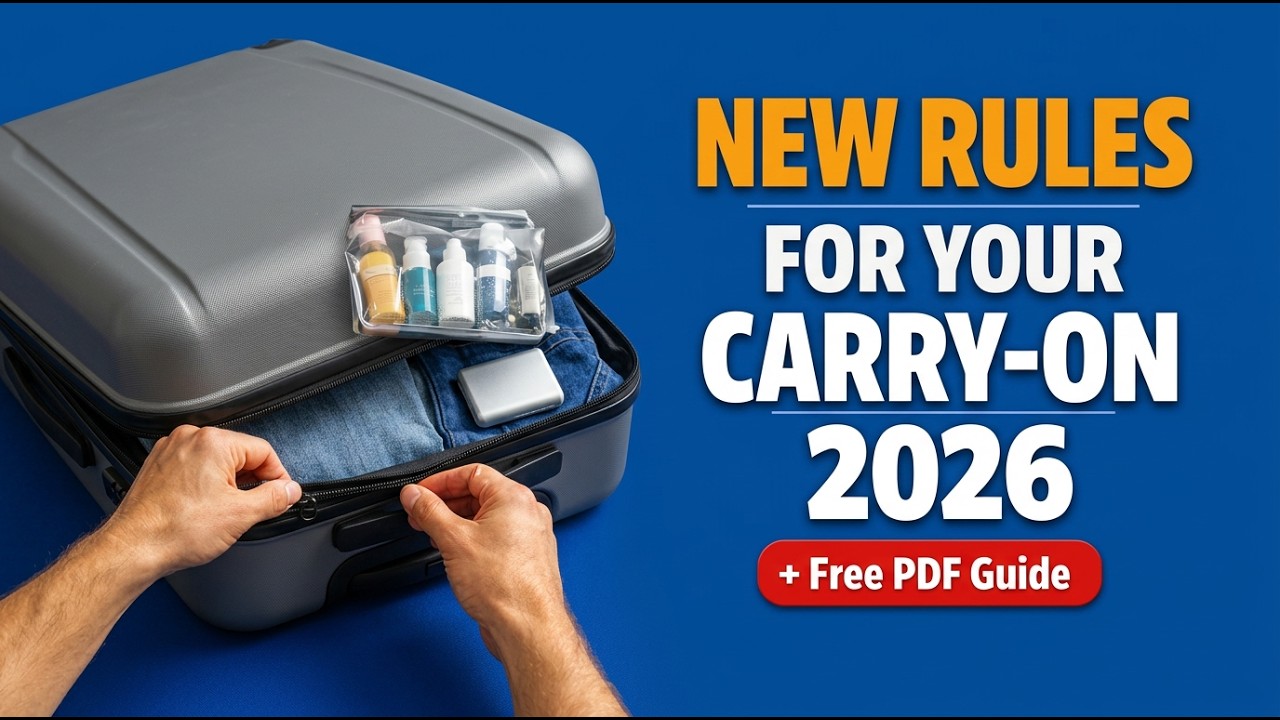
This is the most consistently misunderstood carry-on rule. All spare lithium batteries and power banks must travel in your carry-on, never in a checked bag. Size doesn’t matter. A small power bank in a checked bag violates FAA regulations. If caught during screening, your bag gets pulled and you may miss your flight.
- Under 100 Wh: Free carry-on, no restrictions (covers most smartphones, laptops, and power banks up to ~27,000 mAh)
- 100–160 Wh: Requires airline approval before your flight
- Over 160 Wh: Not allowed on any passenger aircraft
To calculate watt-hours: (mAh ÷ 1,000) × voltage (typically 3.7V). The rating is printed on the battery label.
Smart Luggage: One Test Before You Pack
Smart luggage with a built-in lithium battery must pass one test: can you remove the battery with your bare hands in under 30 seconds?
- Yes: Your bag is compliant. Remove the battery before checking the bag. Carry it in the cabin.
- No (requires any tool): Your bag is banned from the entire flight, not just checked luggage. No exceptions. No appeals at the gate. Travelers have had to leave expensive smart suitcases at the airport.
This rule has been in place under FAA fire safety guidelines since 2018 but is now enforced with zero exceptions in 2026.
Security Checkpoint: What Changed
- Shoes: No longer required to be removed as of July 8, 2025
- Laptops: Still go in a separate bin in standard lanes (stays in bag with TSA PreCheck)
- Liquids (3-1-1 rule): Still applies: 3.4 oz containers, one quart-sized zip bag, one bag per person. At airports with CT scanners, liquids can stay in your bag, but the rule has not been eliminated nationwide
TSA PreCheck costs $85 for five years, is available at 1,300+ enrollment locations, and is covered by many premium credit cards. Global Entry ($120 for five years) includes PreCheck and clears you through international customs.
5 Common Mistakes to Avoid
1. Measuring without wheels and handles. The airline scanner measures the entire object. Measure at home with everything extended before you leave.
2. Power bank in checked bag. All spare lithium batteries are prohibited in checked luggage regardless of size. Pack your power bank last, in your carry-on, every trip.
3. Outdated smart luggage. The bag may have flown in previous years. Enforcement changed in 2026. Test battery removal by hand before you leave for the airport.
4. Not knowing what counts as a liquid. Toothpaste, gel deodorant, peanut butter, sunscreen, lotion, hair gel, liquid makeup all follow the 3-1-1 rule. Switch to solid toiletries to eliminate the issue entirely.
5. Arriving without an ID plan. Check your license for the star this week. If there’s no star and you don’t have a passport, budget $45 per person and 30–45 extra minutes for TSA Confirm.ID at the airport.
Key Details at a Glance
- REAL ID enforced since: May 7, 2025
- TSA Confirm.ID fee: $45 per person, non-refundable, valid 10 days
- Standard carry-on limit: 22 × 14 × 9 inches (includes wheels and handles)
- Gate check fee: Starts at $60 at the gate
- Power banks: Carry-on only, never checked bags
- Smart luggage: Battery must be removable by hand, no exceptions
- Shoes at checkpoint: No removal required (July 2025 rule change)
- TSA PreCheck: $85 / 5 years, 1,300+ enrollment locations
Related GovClarity guides
- Stop Taking Vouchers: Your Federal Flying Rights in 2026
- Real ID 2026: NEW TSA Requirements You MUST Know (Updated Guide)
- Free Museums in Washington DC 2026: What’s Free & What Needs a Reservation
- How to Get a US Passport in 2026: New Rules & Online Renewal
Download the Free Guide
Our free companion guide includes a printable pre-flight carry-on checklist, complete prohibited items list with carry-on vs. checked bag notes, carrier-by-carrier size limits and gate check fee breakdown, full lithium battery watt-hour reference, and smart luggage compliance rules.
Frequently Asked Questions
REAL ID is fully enforced for all domestic U.S. flights as of May 7, 2025. Your driver’s license must show a gold or black star or the words REAL ID. Without it you need a U.S. passport, passport card, or Trusted Traveler card to board.
TSA Confirm.ID is a paid identity verification program launched February 1, 2026 for travelers without REAL ID. It costs $45 per person, takes 10-30 minutes, and does not guarantee boarding. A family of four without compliant IDs faces $180 in fees.
The standard carry-on limit at American, Delta, United, JetBlue, and Alaska is 22 × 14 × 9 inches, including wheels and handles. Southwest allows 24 × 16 × 10 inches. Airlines now use automated gate scanners, so measure your bag fully extended at home.
No. All spare lithium batteries and power banks must travel in your carry-on regardless of size. A small power bank in a checked bag violates FAA regulations. If caught during screening your bag gets pulled and you may miss your flight entirely.
Smart luggage is banned if you cannot remove the battery with your bare hands in under 30 seconds. If removal requires any tool, the bag is prohibited from the entire flight, not just checked luggage. No exceptions and no appeals at the gate.
No. Shoe removal is no longer required at TSA checkpoints as of July 8, 2025. Laptops still go in a separate bin in standard lanes but stay in your bag with TSA PreCheck. The 3-1-1 liquids rule still applies nationwide.
Your bag gets gate-checked immediately and you pay a fee starting at $60, and the rate goes higher depending on the carrier. Pre-paying for a checked bag at booking is typically around $35, so it is always cheaper to check bags before leaving home.
Multiply milliamp-hours divided by 1,000 by the voltage (typically 3.7V). Under 100 Wh is unrestricted carry-on. 100-160 Wh requires airline approval. Over 160 Wh is banned from all passenger aircraft. The rating is printed on the battery label.
Official source: Transportation Security Administration, tsa.gov