How to Apply for WIC in 2025: Step-by-Step Guide
Before you look at how to apply for WIC, two things surprise almost everyone. The income limit is higher than people expect, because WIC uses 185 percent of the federal poverty guidelines rather than 100 percent, so a household of four could earn $59,478 in 2025 and still qualify. And WIC is not money. It is a specific list of foods in specific sizes, loaded onto a card each month.
Watch this step-by-step GovClarity video guide. Subscribe to our YouTube channel for new guides every week.
Information sourced as of September 2025. The income limits below are the 2025 federal guidelines and the program figures are from federal fiscal year 2024, matching our companion PDF guide. Income limits reset every year around July, and each state runs its own WIC agency, so confirm current figures with your local office before you apply.
Two things people get wrong about WIC
First, the income limit is higher than almost anyone expects. WIC uses 185 percent of the federal poverty guidelines, not 100 percent. A household of four could earn $59,478 in 2025 and still qualify. Plenty of working families rule themselves out on a guess and never check.
Second, WIC is not money. It is a specific list of foods in specific sizes, loaded onto a card each month. That distinction is where most of the frustration happens, and it happens at the checkout, not at the application.
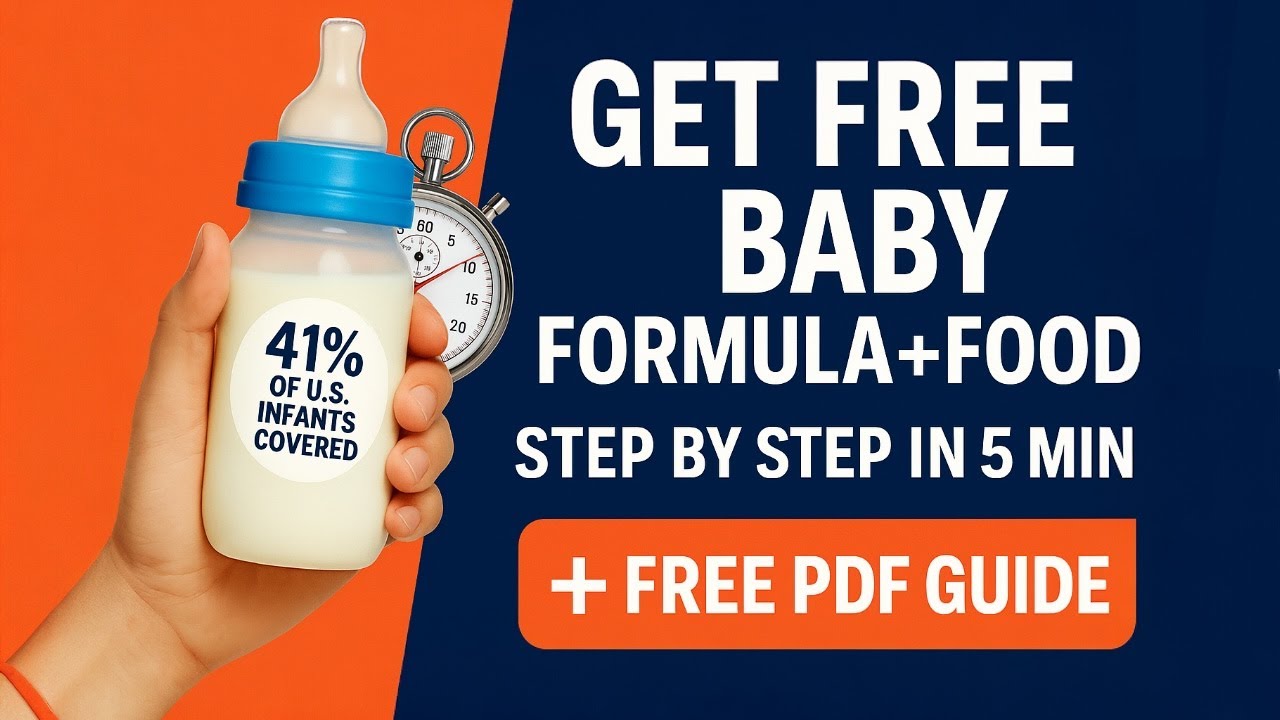
WIC serves about 6.7 million people a month, including roughly 41 percent of all infants born in the United States. It is not a fringe program.
What WIC is
WIC stands for the Special Supplemental Nutrition Program for Women, Infants, and Children. It is a federal nutrition program that provides specific healthy foods, nutrition education, breastfeeding support and healthcare referrals to lower income pregnant women, new mothers, and children under age 5.
The comparison people reach for is the Supplemental Nutrition Assistance Program, usually called SNAP, but they do different jobs. SNAP is general food money. WIC targets a short, expensive window of development with a defined set of foods, plus clinical support around it. You can receive both at the same time, and receiving WIC does not reduce your SNAP benefit.
Who WIC serves
| Category | How long you are eligible | Worth knowing |
|---|---|---|
| Pregnant women | Through pregnancy and 6 weeks after birth | High risk pregnancies included |
| Breastfeeding mothers | Up to 1 year after birth | Larger food package than the non breastfeeding one |
| Non breastfeeding mothers | Up to 6 months after birth | Standard package |
| Infants | Birth to 12 months | Formula provided where it is needed |
| Children | Ages 1 to 4 | Coverage ends at the fifth birthday, so reapply before it |
| Fathers, grandparents and other guardians | While caring for an eligible child | You apply on the child’s behalf. You do not have to be the mother |
| Foster children | Under age 5 | Automatically income eligible |
That guardian row is the one most often missed. A father, a grandmother or a foster carer can bring an eligible child to a WIC appointment and apply on their behalf.
Income guidelines for 2025
| Household size | Annual | Monthly | Weekly |
|---|---|---|---|
| 1 | $28,953 | $2,413 | $557 |
| 2 | $39,128 | $3,261 | $753 |
| 3 | $49,303 | $4,109 | $948 |
| 4 | $59,478 | $4,957 | $1,144 |
| Each additional person | Add $10,175 | Add $848 | Add $196 |
An unborn baby counts as a household member. A pregnant woman living alone is a household of two, not one, which moves her limit from $28,953 to $39,128.
The shortcut most applicants qualify for
If you already receive SNAP, Medicaid or Temporary Assistance for Needy Families, you are automatically income eligible for WIC. You do not need to document your income at all. You bring proof of the benefit instead, which is usually the card or the award letter.
This removes the single most tedious part of the application. If it applies to you, say so when you book the appointment so the office tells you the shorter document list.
You also need to live in the state where you apply, but there is no minimum residency period. Temporary residents and migrant families are eligible.
Nutritional risk, and why it is not the obstacle it sounds like
Alongside income and category, WIC requires a nutritional risk. The phrase puts people off, because it sounds like something you have to prove in advance and might fail.
You do not prove it. It is assessed for you, free, at the appointment, and it covers a wide range:
- Medical risks such as anemia, lead exposure or a difficult previous pregnancy
- Dietary risks such as an inadequate diet or limited access to food
- Physical measurements, meaning height, weight and growth
- Blood tests for anemia and lead levels where needed
Most applicants meet the requirement. Treat the screening as a free professional health assessment for you or your child rather than a hurdle.
How to apply for WIC
1. Find your local office
WIC is delivered locally, often through health departments and community health centres. Use the state directory at fns.usda.gov/wic/wic-contacts, or call your local health department.
2. Book an appointment
Appointments are generally required rather than optional, though some offices take walk ins. Ask two things when you call: whether they offer virtual pre screening, and whether you need an interpreter. Both are commonly available and neither is usually offered unprompted.
3. Bring the right documents
- Identity for each applicant: photo identification, a birth certificate, or a Social Security number where one exists
- Proof of address: a utility bill, a lease, or official mail
- Either benefits or income: your SNAP, Medicaid or Temporary Assistance for Needy Families card or award letter, or four weeks of income proof such as pay stubs, self employment records, unemployment, Social Security or child support
- Immunization records for children
- Proof of pregnancy such as a doctor’s statement or an ultrasound
- Any relevant medical records
What the appointment is actually like
Budget 60 to 90 minutes. Bring something to occupy a small child. Four things happen:
| Stage | Roughly | What happens |
|---|---|---|
| Document review | 15 minutes | Staff verify your paperwork and eligibility |
| Health screening | 20 to 30 minutes | Height and weight, an anemia blood test, and optional lead screening |
| Nutritional assessment | 20 to 30 minutes | A conversation about eating habits, and personalised education |
| Benefits issued | 10 to 15 minutes | Your eWIC card is set up and your food package is explained |
In most cases you leave the same appointment with a working card. This is not a program where you apply and wait weeks for a decision.
What you actually receive
A food package, not a dollar amount you can spend freely. The categories are dairy, protein, whole grains, fresh produce through what is called the Cash Value Benefit, and infant nutrition where relevant.
| Who you are | What the package includes |
|---|---|
| Pregnant or breastfeeding | Milk, cheese and eggs, whole grain cereal and bread, a Cash Value Benefit for fruit and vegetables, and protein such as legumes, peanut butter or canned fish |
| Fully breastfeeding | All of the above plus a larger produce benefit, whole grain tortillas or brown rice, and extra milk and cheese |
| Infants, 0 to 6 months | Iron fortified formula where the baby is not fully breastfed |
| Infants, 6 to 12 months | Iron fortified infant cereal, baby food including fruit, vegetables and meat, and formula if needed |
| Children, 1 to 4 | Milk, cheese, eggs, whole grain cereal and bread, a Cash Value Benefit for produce, legumes and peanut butter |
Notice that the fully breastfeeding package is materially larger. That is deliberate, and it is worth knowing before you decide how to feed.
The part of WIC that is not food
People sign up for the groceries and then discover the rest, which for many families turns out to be the more valuable half.
- Breastfeeding support: lactation counselling, peer counsellors, support groups, and breast pump loans including hospital grade pumps in some cases. A pump alone can be worth several hundred dollars
- Nutrition education: one to one counselling, and classes on meal planning, food safety and cooking, with multilingual materials
- Healthcare referrals: connections to providers, immunizations, prenatal care coordination, and mental health and substance use resources
- Community resources: food banks, housing help, childcare and transportation
Using the eWIC card without losing benefits
The card works like a debit card, with four rules that catch people out:
- It buys approved foods in approved brands and sizes only. A different size of the same cereal will decline
- Benefits load monthly on an assigned date and expire at the end of that month. They do not roll over
- There is no cash back
- Only authorised stores accept it
Before you shop: bring the shopping guide your office gave you, check your balance through the app or by calling the number on the card, and buy your WIC items first. In the store, look for the WIC shelf labels, keep WIC items separate, and run them as their own transaction. Mixing WIC and non WIC items in one transaction is the most common reason a checkout goes wrong.
Staying enrolled
WIC certifies you for a set period rather than indefinitely, and it is your responsibility to renew before it lapses.
| Category | Certification length |
|---|---|
| Pregnant women | Until 6 weeks after birth |
| Breastfeeding women | 6 months to 1 year |
| Postpartum women | 6 months |
| Infants | 6 months to 1 year |
| Children | 6 months to 1 year |
Recertification means a new appointment, updated income or benefit proof, and a fresh health screening. Book it before the current period expires rather than after.
Report these within 10 days: a change of address, a change in income, a change in family size, or a change in pregnancy status.
Extra benefits worth asking about
The Farmers Market Nutrition Program gives an additional $10 to $30 a year in vouchers for fresh produce at participating farmers markets. It runs in most states during the growing season and it is separate from your regular package, so it has to be requested.
Specific populations are accommodated: military families are served on bases worldwide, migrant workers have arrangements for seasonal movement, families experiencing homelessness get flexibility on documentation, and Native American families are served in coordination with tribal programs.
When something goes wrong
If you are denied, ask for the reason in writing and ask about the appeals process. Denials are frequently a missing document rather than a judgement on eligibility, and supplying it resolves it.
If you miss an appointment, reschedule immediately and explain. Benefits may be suspended but are usually restored. Repeated misses can force a fresh application.
If your card declines, check the brand, the size, the store and the expiry date before assuming the card is broken. Those four account for nearly every failed transaction.
If you move to another state, contact the new state’s WIC office with your identification, case number and benefit documentation. Your case transfers. You do not start over.
📥 Free PDF Guide
Our free 21 page guide has the full income table, the document checklist, the food packages by category, the eWIC shopping rules and the national contact list. No email required.
Browse all our guides on the Free Guides page.
Frequently asked questions
Do I have to be unemployed to get WIC?
No. WIC uses 185 percent of the federal poverty guidelines, which is well above the poverty line itself. Many working households qualify, and a working household of four could earn $59,478 in 2025 and still be eligible.
Can fathers and grandparents apply?
Yes. Any parent or guardian caring for an eligible child can apply on that child’s behalf. The child is the participant, not you.
Can I get WIC and SNAP at the same time?
Yes, and receiving WIC does not reduce your SNAP benefit. They are separate applications. Being on SNAP also makes you automatically income eligible for WIC.
Does a pregnancy count toward household size?
Yes. An unborn baby counts, so a pregnant woman living alone is treated as a household of two for the income test.
How long does approval take?
Usually one appointment. Eligibility is decided during the visit and in most cases the eWIC card is issued before you leave.
What happens when my child turns 5?
WIC eligibility ends. Look at the National School Lunch Program and, if you are not already receiving it, SNAP. Ask your WIC office about the handover before the birthday rather than after.
Can I use WIC benefits at any store?
No. Only WIC authorised stores accept the card, and only for approved brands and sizes. Your office provides a shopping guide listing both.
Do unused benefits roll over to next month?
No. Benefits load monthly and expire at the end of that month. Check your balance mid month so nothing is left behind.
Related GovClarity guides
- How to Apply for LIHEAP: Winter Heating Help 2025
- Can’t Afford Groceries? How to Get Up to $975/Month in SNAP Benefits (2025 Guide)
- FEMA Help: Your Step-by-Step Disaster Relief Guide (In Under 5 Minutes)
- FAFSA 2026-2027: Avoid Mistakes That Cost Thousands
Official resources
- Find your state and local WIC office: fns.usda.gov/wic/wic-contacts
- Federal program page: fns.usda.gov/wic
- WIC Works resource library: wicworks.fns.usda.gov
- National Breastfeeding Helpline: 1-800-994-9662
- Immediate food help: dial 2-1-1, or feedingamerica.org for local food banks
Details as of September 2025, using the 2025 income guidelines and federal fiscal year 2024 program data. Income limits reset annually and each state runs its own WIC agency, so confirm current details with your local office before applying. GovClarity is not a government agency and does not process applications. Applying for WIC is always free.