
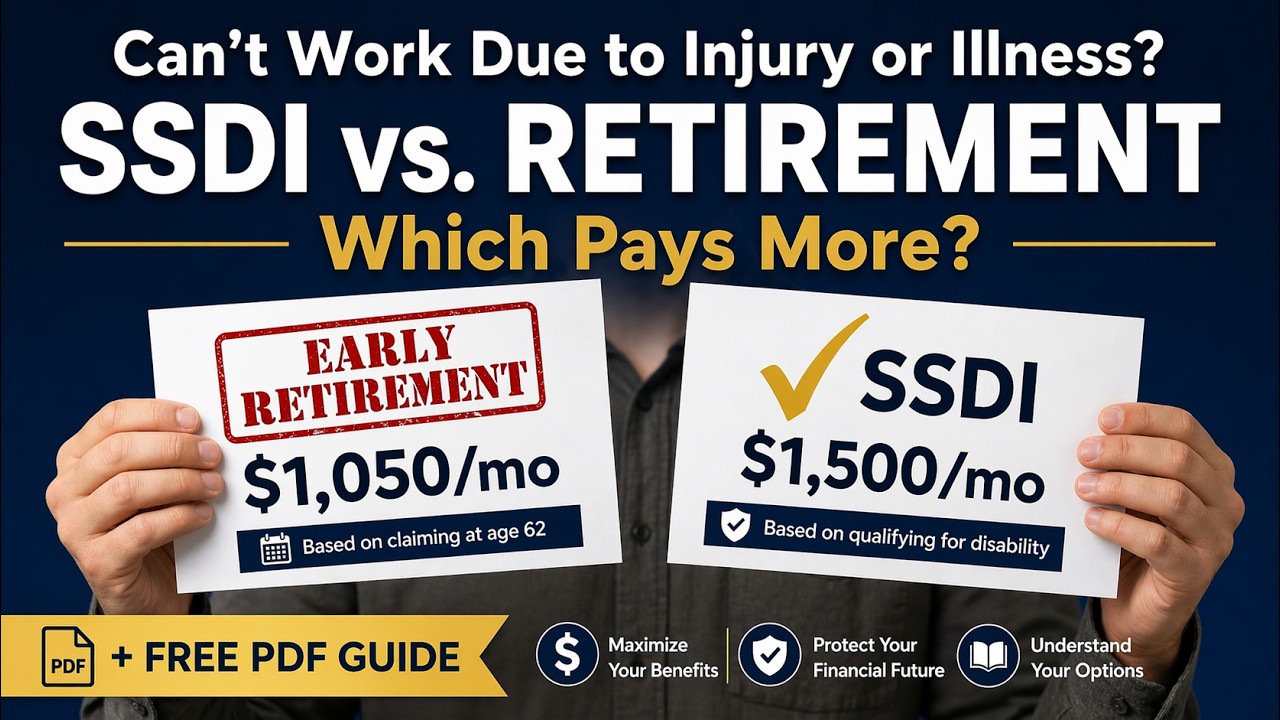
Can’t Work Due to Injury or Illness? SSDI vs. Early Retirement (2026)
Choosing between SSDI vs early retirement is one of the hardest calls you can face when a health condition forces you out of work. If you’re in your late 50s or early 60s and can no longer work due to a health condition, you may be facing one of the most consequential financial decisions of your life: should you file for early Social Security retirement or apply for Social Security Disability Insurance (SSDI)?
The difference isn’t just administrative. It can permanently affect how much money you receive every single month for the rest of your life. Filing for the wrong program first could cost you hundreds of dollars a month that you can never get back.
SSDI vs Early Retirement: The Key Difference
Both programs are run by the Social Security Administration and pay a monthly benefit based on your work history. But they are built on completely different rules.
Social Security Retirement is based on age. If you claim at 62, the earliest possible age, your benefit is permanently reduced by up to 30%. That reduction stays with you for the rest of your life.
SSDI (Social Security Disability Insurance) is based on disability. If you qualify, the SSA pays you as if you had already reached your full retirement age, meaning 100% of your calculated benefit, even if you’re only 55 or 60 years old.
The Real Dollar Difference
Let’s say your full retirement benefit would be $1,500 a month at age 67. If you claim early retirement at 62, you receive around $1,050 a month, permanently. If you qualify for SSDI instead, you receive the full $1,500. That’s $450 a month, or more than $5,400 a year, every year for the rest of your life.
Who Qualifies for SSDI?
To qualify for SSDI, you need to meet two tests:
- Medical test: You must have a condition that prevents you from earning more than $1,690 per month (the 2026 Substantial Gainful Activity limit) and has lasted or is expected to last at least 12 months.
- Work history test: Most workers over 31 must have earned 20 work credits in the last 10 years. Critically, your SSDI coverage has an expiration date, called your Date Last Insured (DLI). If you wait too long to apply, your coverage may have expired.
Importantly, for workers over 55, the SSA’s “Grid Rules” mean you don’t have to prove you can’t do any work, only that you can no longer perform your past type of work and realistically can’t retrain for something else at your age.
The Medicare Advantage
SSDI doesn’t just pay more. It can also get you Medicare 2 to 3 years earlier. Early retirees at 62 must wait until age 65 for Medicare. SSDI recipients become eligible for Medicare 24 months after cash benefits begin. For someone with pre-existing conditions, that gap in coverage can cost $800 to $1,500 or more per month in private insurance premiums.
What If You Need Income While Waiting?
SSDI applications often take 3 to 6 months, and many are denied initially and require an appeal. If you need income while waiting, you can apply for early retirement as a bridge. If your SSDI is later approved, the SSA will pay you the difference as a retroactive lump sum (up to 12 months back). Just understand the risk: if your SSDI claim is ultimately denied, you stay on the reduced retirement benefit permanently.
2025 Law Change: Government Workers Now Benefit Too
In January 2025, the Social Security Fairness Act repealed the Windfall Elimination Provision (WEP) and Government Pension Offset (GPO), two rules that reduced Social Security benefits for teachers, police officers, firefighters, and other government workers with pensions. If this applies to you, contact SSA at 1-800-772-1213 to confirm your updated benefit amount.
The 4 Mistakes to Avoid
- Filing for early retirement when you qualify for SSDI , a permanent 30% reduction you can’t undo after 12 months.
- Waiting too long to apply . Your Date Last Insured has an expiration date. Apply now, not at 62.
- Assuming you won’t qualify . The SSA evaluates your specific condition and age. Apply and let them decide.
- Earning over the limit while applying . Earning more than $1,690/month while your application is pending can disqualify you.
Related GovClarity guides
- SSDI Denied? How to Appeal in 2026 (Step-by-Step + Free Guide)
- Social Security Spousal Benefits Explained: Who Qualifies & How to Apply (2026)
- Social Security Overpayments? Do THIS Now
- How to Apply for Social Security Benefits in 2025: Complete Guide in Under 5 Minutes
- How to Apply for Social Security Benefits in 2027 (Apply 4 Months Early)
Download the Free 2026 Guide
We’ve put together a free, complete guide covering everything in this video, including eligibility checklists, the full benefit reduction table, the Medicare timeline comparison, and step-by-step instructions for applying.
GovClarity simplifies government procedures so you can protect your benefits and financial future with confidence.
Frequently Asked Questions
Social Security retirement is age-based, so claiming at 62 permanently reduces your benefit by up to 30%. SSDI is disability-based, so if you qualify, you receive 100% of your full retirement benefit even at age 55 or 60. The reduction with retirement stays for life.
If your full retirement benefit is $1,500 a month at 67, claiming early retirement at 62 reduces it to about $1,050, permanently. SSDI pays the full $1,500. That is $450 more per month, over $5,400 a year, for the rest of your life.
You need a medical condition that prevents earning over $1,690 per month and has lasted or will last 12+ months. Most workers over 31 also need 20 work credits in the last 10 years. Your SSDI coverage has a Date Last Insured, so apply before it expires.
DLI is the expiration date of your SSDI coverage based on recent work history. If you wait too long after stopping work, your DLI passes and you no longer qualify for SSDI even if you become disabled. Apply as soon as you can no longer work, not at age 62.
SSDI recipients become eligible for Medicare 24 months after cash benefits begin, which is 2 to 3 years earlier than the standard age 65. For someone with pre-existing conditions, this gap can save $800 to $1,500 or more per month in private insurance premiums.
Yes. SSDI applications take 3 to 6 months and are often denied initially. Early retirement can serve as a bridge for income. If SSDI is approved, SSA pays the difference as a retroactive lump sum (up to 12 months back). If denied, you stay on the reduced benefit.
Initial decisions typically take 3 to 6 months. Many claims are denied initially and require an appeal, which adds many more months. For workers over 55, the SSA’s Grid Rules make approval easier, because you only need to show you cannot do your past type of work.
The Act, signed January 2025, repealed the Windfall Elimination Provision (WEP) and Government Pension Offset (GPO). Teachers, police officers, firefighters, and other public-sector workers with pensions no longer have their Social Security benefits reduced. Call 1-800-772-1213 to confirm your updated benefit.
Official source: Social Security Administration, ssa.gov