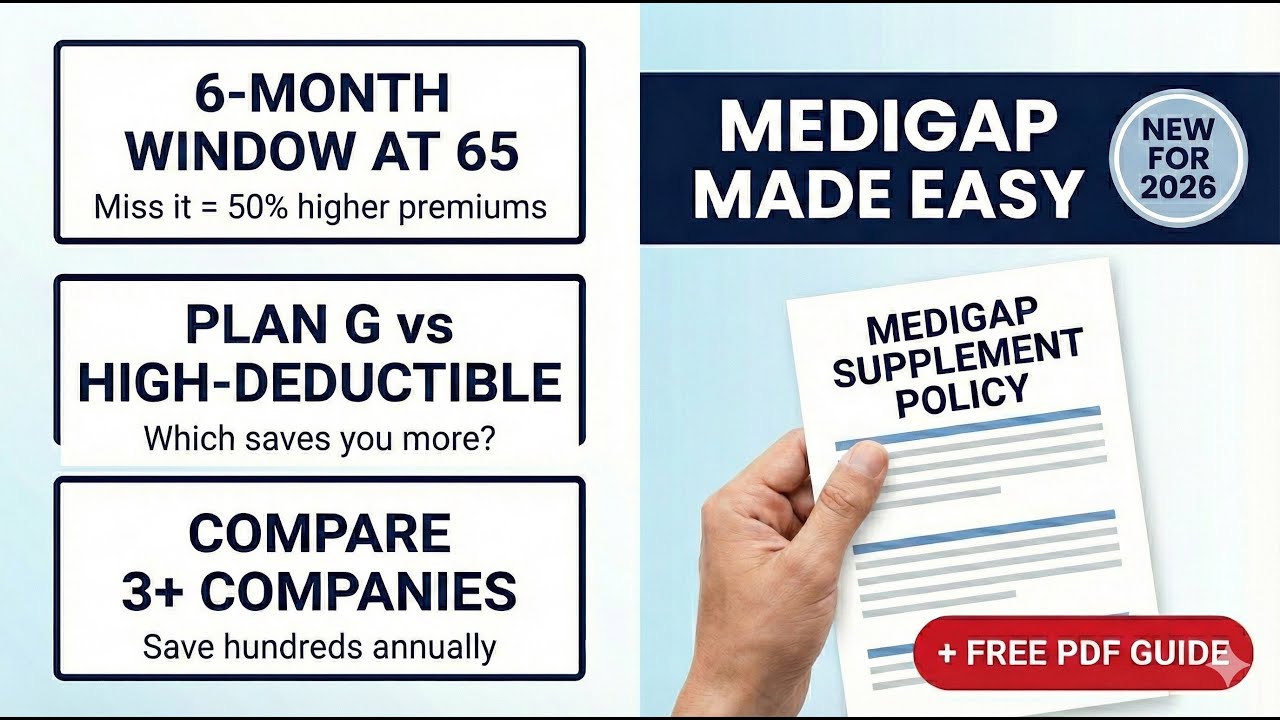
Medigap Plans Explained: Don’t Miss Your 6-Month Window (2026 Guide)
Medigap gives you one six month window, once, and it never comes back. It opens the first month you are both 65 or older and enrolled in Medicare Part B. Inside it, insurers cannot refuse you or charge you more because of your health. Outside it, they can screen you, charge 30 to 50 percent more, or decline you entirely.
Watch this step-by-step GovClarity video guide. Subscribe to our YouTube channel for new guides every week.
Information sourced as of December 2025. The 2026 figures and plan rules below were current when this guide was published and match our companion PDF. Premiums and deductibles change annually, so confirm at medicare.gov before enrolling.
The one thing to take away
You get a single six month window, once, and it never comes back. It starts the first month you are both 65 or older and enrolled in Medicare Part B.
Inside it, insurers cannot refuse you, cannot charge you more for your health, and must sell you any policy they offer in your area.
Outside it, they can screen your health, charge 30 to 50 percent more, impose waiting periods, or decline you entirely. This is the difference between a guaranteed policy and no policy at all.
What Medigap is
Medicare Supplement Insurance, usually called Medigap, is private insurance that helps pay costs Original Medicare, meaning Parts A and B, does not cover. That includes copayments, coinsurance and deductibles.
To buy a policy you must be enrolled in both Medicare Part A and Part B, be 65 or older in most states, and pay a monthly premium on top of your Part B premium. Some states offer Medigap to people under 65 with disabilities or specific conditions, so check with your State Insurance Department.
The rule that catches people out: Medigap cannot be used alongside a Medicare Advantage plan. You must be on Original Medicare for a Medigap policy to work. If you are weighing the two, see our Medicare Advantage versus Medicare Supplement guide.
Medigap does not cover long term care, vision, dental, hearing aids, eyeglasses, private duty nursing, or prescription drugs. Drugs require a separate Medicare Part D plan.
Your six month window, and what happens if you miss it
Your Medigap Open Enrollment Period is a one time, six month window that begins the first month you have Medicare Part B and are 65 or older.
An example. If you turn 65 in June and enrol in Part B that same month, your window runs from June 1 through November 30.
During that window, insurance companies cannot deny you coverage because of pre existing conditions, cannot charge you a higher premium because of your health, and must sell you any policy they offer in your area.
If you miss it, companies can charge 30 to 50 percent higher premiums, require medical underwriting, deny coverage outright for conditions such as diabetes or heart disease, and impose waiting periods before pre existing conditions are covered.
Start researching two to three months before the window opens, not during it.
The plans, compared
Medigap plans are standardised and labelled by letter. A Plan G from one company covers exactly what a Plan G from another company covers. Only the premium and the service differ, which makes shopping around straightforward.
| Benefit | A | B | D | G | High Deductible G | K | L | M | N |
|---|---|---|---|---|---|---|---|---|---|
| Part A hospital coinsurance | 100% | 100% | 100% | 100% | 100% after deductible | 100% | 100% | 100% | 100% |
| Part B coinsurance | 100% | 100% | 100% | 100% | 100% after deductible | 50% | 75% | 100% | 100%* |
| Blood, first 3 pints | 100% | 100% | 100% | 100% | 100% after deductible | 50% | 75% | 100% | 100% |
| Part A hospice coinsurance | 100% | 100% | 100% | 100% | 100% after deductible | 50% | 75% | 100% | 100% |
| Skilled nursing facility | No | No | 100% | 100% | 100% after deductible | 50% | 75% | 100% | 100% |
| Part A deductible | No | 100% | 100% | 100% | 100% after deductible | 50% | 75% | 50% | 100% |
| Part B deductible | No | No | No | No | No | No | No | No | No |
| Part B excess charges | No | No | No | 100% | 100% after deductible | No | No | No | No |
| Foreign travel emergency | No | No | 80% | 80% | 80% after deductible | No | No | 80% | 80% |
| Out of pocket limit | None | None | None | None | $2,950 | $6,940 | $3,470 | None | None |
*Plan N requires copayments of up to $20 for office visits and up to $50 for emergency room visits that do not result in admission.
Plans C and F are only available to people who were eligible for Medicare before January 1, 2020. If you became eligible after that date, they are not an option.
Plan G, the most popular choice
Plan G covers everything except the Part B deductible, which is $283 in 2026. Once you have met that deductible you typically pay nothing for Medicare approved services. You pay the monthly premium and that deductible, and little else.
Plan N, the lower premium alternative
Plan N covers the same ground as Plan G with two exceptions. It does not cover Part B excess charges, which can run up to 15 percent above the Medicare approved amount if your doctor does not accept assignment. And it carries small copayments, up to $20 for office visits and up to $50 for emergency room visits that do not lead to admission.
High Deductible Plan G
The same coverage as Plan G with a much lower premium, but you must meet an annual out of pocket threshold of $2,950 in 2026 before the plan pays anything. After that it covers 100 percent of approved costs.
How to compare the actual cost
Because the coverage is identical across companies for a given letter, the comparison is about price and reliability. Work it out in four steps.
- Get quotes from at least three companies for the same plan letter.
- Add the Part B deductible, $283 in 2026, which applies to every plan currently sold.
- If you are considering Plan N, estimate the extras: expected office visits multiplied by up to $20, expected emergency visits multiplied by up to $50, and any excess charges based on whether your doctors accept Medicare assignment.
- Total it up per plan and compare like for like.
The cheapest quote today is not always the best value. Ask about the company’s history of premium increases, its financial stability rating, and its customer service reputation. A policy you keep for twenty years is a long relationship.
Your enrollment checklist
Before your window opens
- Confirm your Medicare Part B enrollment date
- Mark the six month window on your calendar
- Research which plans are available in your area
- Get premium quotes from several companies
- Check whether your doctors accept Medicare assignment
- Review your typical medical usage and what you expect to need
During your window
- Choose your plan letter, then your company
- Complete and submit the application early in the window, not at the end
- Keep copies of everything you send
- Confirm the application was received
- Pay your first premium
After enrolling
- Verify your coverage start date
- Read the policy when it arrives
- Set up premium payment
- Create an account at medicare.gov
- Keep your Medicare and Medigap cards together
- Report any errors immediately
📥 Free PDF Guide
Download our free step-by-step guide for this topic. No email required.
Browse all our guides on the Free Guides page.
Frequently asked questions
When is the Medigap open enrollment period?
It is a one time six month window beginning the first month you are 65 or older and enrolled in Medicare Part B. It does not repeat annually and it does not come back.
What happens if I miss the six month window?
Insurers can require medical underwriting, charge 30 to 50 percent more, impose waiting periods for pre existing conditions, or decline you altogether.
Which Medigap plan is best?
Plan G is the most popular for people newly eligible, covering everything except the Part B deductible. Plan N costs less each month but adds small copayments and leaves excess charges uncovered. High Deductible Plan G suits people comfortable carrying $2,950 of risk for a much lower premium.
Can I have Medigap and Medicare Advantage together?
No. Medigap only works alongside Original Medicare. You cannot use a Medigap policy while enrolled in a Medicare Advantage plan.
Does Medigap cover prescription drugs?
No. You need a separate Medicare Part D plan for prescriptions.
Are Plan G policies identical between companies?
Yes. Medigap plans are standardised by letter, so the benefits are the same wherever you buy. Premiums, rate increase history and service are what differ.
Can I get Medigap under 65?
In some states, for people with disabilities or specific conditions. Check with your State Insurance Department, since the rules vary considerably.
Related GovClarity guides
- Health Insurance 2027: What Changed and Who Still Qualifies
- Medicare Open Enrollment 2027: What to Check Before December 7
Official resources
- Compare Medigap policies in your area: medicare.gov/medigap-supplemental-insurance-plans
- Medicare by phone: 1-800-633-4227, TTY 1-877-486-2048, 24 hours a day
- Free one to one counselling from your State Health Insurance Assistance Program: shiphelp.org. They are independent and do not sell insurance
- Your State Insurance Department for rules specific to your state
Details as of December 2025, with 2026 figures. Premiums, deductibles and plan availability change, so verify at medicare.gov before enrolling. GovClarity is not a government agency and does not sell insurance.